Learn English on Foot: A Walker’s Guide to the Scottish Highlands
The Scottish Highlands might be the most beautiful English classroom there is. Why walking is a brilliant, low-pressure way to practise — plus the hill vocabulary you’ll need and walks graded by your level, from an easy loch circuit to Ben Nevis.
Par Parlazo
17 August 2026 · Mis à jour le 23 October 2026 · 6 min de lecture
Here is a sentence you don’t hear in language schools: the fastest way to get comfortable speaking English might be to put on a pair of boots and walk up a Scottish mountain. Stay with me. The Highlands are wet, wild, and gloriously empty — and for an English learner they are close to the perfect classroom. You get real conversation with friendly strangers, a whole vocabulary you’ll actually use, and the one thing a textbook can never give you: a reason to talk that has nothing to do with grammar.
This guide covers why walking is such good language practice, the Highland words you’ll need, and a handful of walks sorted by how hard they are — so you can match the route to your level, exactly the way you’d pick a book or a podcast. For the full routes, maps and up-to-date conditions, the walkers’ bible is Walkhighlands, which grades every walk from 1 (a gentle stroll) to 5 (a serious mountain day).
Why walking is secretly a brilliant English lesson
Speaking a new language face to face is stressful — the eye contact, the pressure to perform, the silence when you’re searching for a word. Walking removes almost all of that. You’re side by side, not face to face, both looking at the view, and the silences feel natural rather than awkward. People relax, and relaxed people talk more.
You also get language in context. When someone points and says “watch your footing, it’s a bit boggy there,” you learn “boggy” and “watch your footing” in one go, and you never forget them, because you were standing in the bog. And Highland walkers are chatty: pass someone on a path and you’ll almost always get a “morning!” or a comment on the weather. Every one of those is a tiny, low-stakes speaking exercise, and you can get twenty of them in a day.
The Highland words you’ll actually need
Half the fun — and half the vocabulary — is that Scottish hills come with their own language, much of it borrowed from Gaelic. Learn these before you go:
- Ben (from Gaelic beinn) — a mountain. Ben Nevis, Ben Lomond.
- Glen (gleann) — a valley. Glen Coe, Glen Nevis.
- Loch — a lake (say the ch like in “Bach,” not “lock”).
- Munro — a Scottish mountain over 3,000 feet. Climbing them all is a national obsession called Munro-bagging.
- Corrie (coire) — a bowl-shaped hollow carved into a mountainside.
- Bothy — a basic stone shelter, free to use, in the middle of nowhere.
- Cairn — a pile of stones marking the path or the summit.
- Scramble — steep ground where you use your hands as well as your feet.
- Boggy — wet, muddy ground. Walkhighlands even rates each walk’s “bog factor.”
- Dreich — a wonderful Scots word for grey, wet, miserable weather. You will need it.
Walks to match your level
Just like listening practice, the trick is to pick something that stretches you without defeating you. Here are real Highland walks, from gentle to serious — look each one up on Walkhighlands for the route and current conditions before you set off.
Easy — gentle, sociable, low-pressure (Walkhighlands grade 1–2)
Flat, well-marked, and busy enough that you’ll pass plenty of people to say hello to. Perfect if your speaking is still finding its feet.
- Loch an Eilein (Cairngorms, near Aviemore) — a flat, wooded circuit of a beautiful loch with a ruined castle on an island. Red squirrels, families, and easy chat. About 5km.
- The Fairy Pools (Isle of Skye) — a short there-and-back to a chain of impossibly clear blue-green pools beneath the Cuillin mountains. Hugely popular, so you’ll never be short of someone to talk to.
- Steall Falls (Glen Nevis, near Fort William) — a dramatic gorge walk to one of Scotland’s highest waterfalls, with a wobbly wire bridge at the end if you’re brave.
Moderate — a proper hill, but achievable (grade 3)
A bit of climbing and a real sense of achievement. Fewer people, so the conversations you do have tend to be longer.
- The Old Man of Storr (Isle of Skye) — a short, steep climb to the foot of a giant rock pinnacle, with jaw-dropping views over the sea. The most photographed spot in the Highlands for good reason.
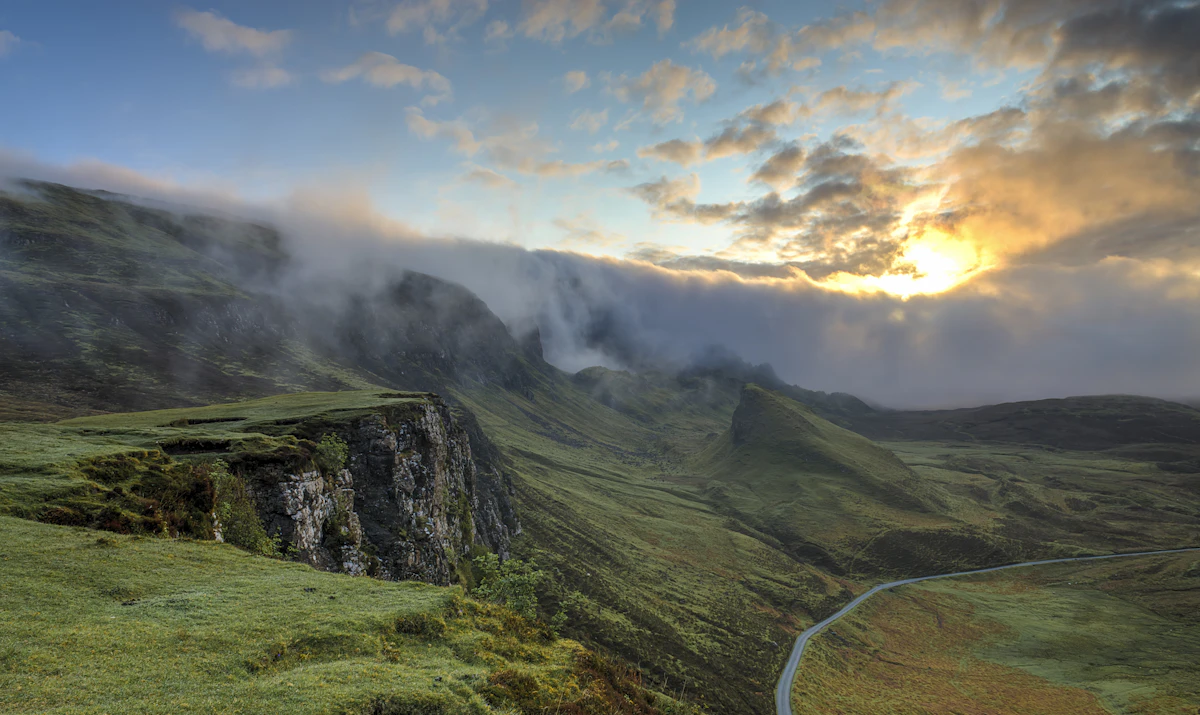
- The Quiraing (Isle of Skye) — a circular walk through a surreal, otherworldly landslip of green ridges and pinnacles (that’s it in the photo above).
- Ben Lomond (Loch Lomond) — the most accessible Munro in the country, an easy trip from Glasgow, with the loch spread out below you the whole way up.
- The Lost Valley (Glen Coe) — a rugged scramble into a hidden hanging valley where, legend says, the MacDonalds once hid their cattle. Pure Highland drama.
Hard — a serious mountain day (grade 4–5)
For confident walkers and confident speakers. Long, steep, and weather-dependent — don’t attempt these without checking the forecast and the route on Walkhighlands first.
- Ben Nevis (Fort William) — at 1,345m, the highest mountain in Britain. The Mountain Track is a long, unrelenting slog, but standing on the roof of the country is a story you’ll be telling — in English — forever.
- The Cobbler (Arrochar) — a distinctive three-peaked hill with a famous “thread the needle” move through a hole in the rock to reach the true summit. Not for anyone who dislikes heights.
How to actually talk to people on the trail
This is where the English happens. Walkers are one of the friendliest tribes on earth, and a few ready-made phrases will get you into a dozen conversations a day:
- “Cracking day for it!” — the standard greeting when the weather is good. It works every time.
- “How far to the top?” / “Is the path clear from here?” — useful, and an easy way to start chatting to someone coming down.
- “Have you done this one before?” — opens the door to advice, stories, and recommendations.
- “It’s a bit dreich the day.” — pull this out when it’s grey and wet and watch a Scot’s face light up.
- “Mind how you go.” — a warm way to say goodbye and “take care” as you pass.
You’ll also get a crash course in Scottish English: wee (small — “just a wee bit further”), aye (yes), ken (know), and the famous rolling Highland accent, which is actually one of the clearer ones for learners. The place names are a bonus history lesson: nearly all of them come from Gaelic and describe the landscape they sit in.
Before you go
Two honest warnings. First, Highland weather changes in minutes — take layers, a map, and check the forecast; Walkhighlands lists the grade, distance and latest conditions for every route. Second, from June to August the Highlands have midges — tiny biting insects that are the one thing no amount of English will help you with. Bring repellent.
And here’s the thing about all this real-world speaking: it works far better if you’ve warmed up first. The walkers you meet won’t slow down for you, so the skill to practise beforehand isn’t vocabulary — it’s listening to natural, unscripted English and replying in real time. That’s exactly what a one-to-one lesson is for. At Parlazo you can book English lessons one at a time, with no subscription — a few conversation lessons before your trip and you’ll be swapping stories on the summit instead of just nodding along. Enjoy the hills.
Une phrase gratuite chaque semaine
Une phrase utile en anglais ou en espagnol dans votre boîte mail chaque semaine. Pas de spam, désabonnement à tout moment.


